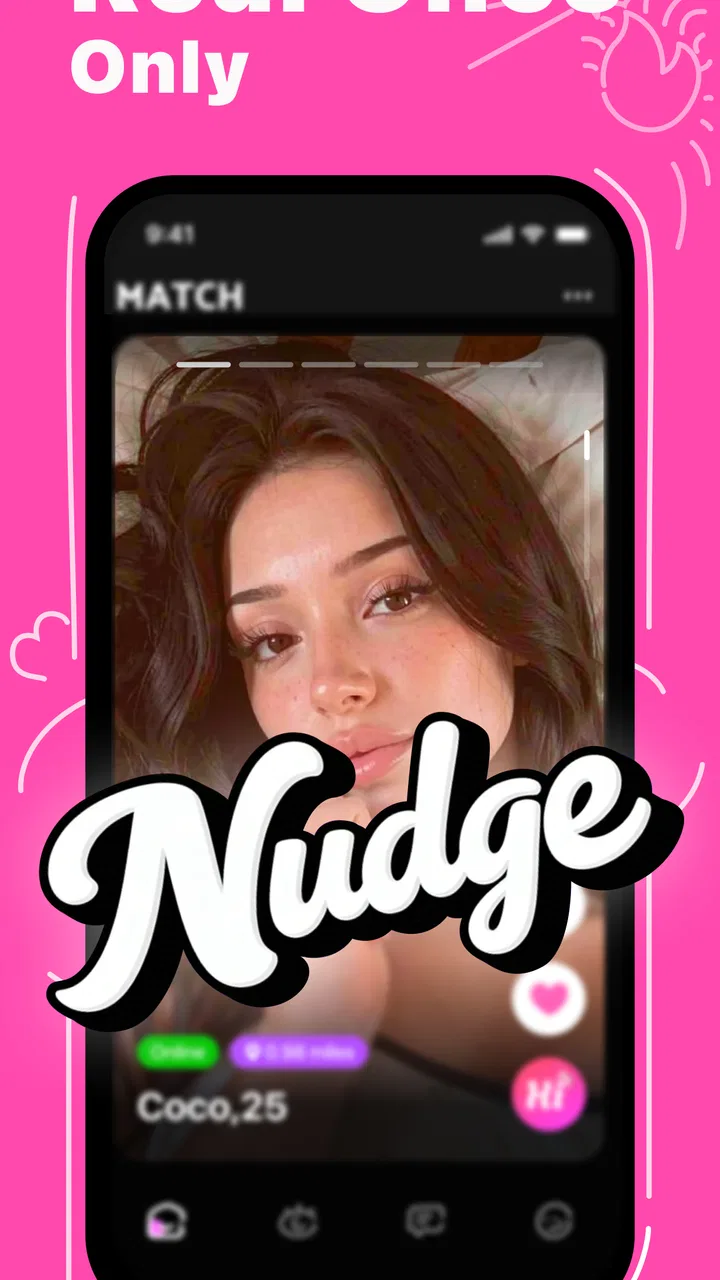
Nudge:The Casual Dating App
- 4.6
- Rating
- 10.00K
- Installs
- Free
- Price

 Analysis by App-foxy
I approached Nudge as a social app for people who want dating and friendship to feel more immediate than a long profile exchange. Its basic idea is easy to understand: discover open-minded singles, react to people who interest you, and see whether that interest becomes a match. In practice, the quality of the experience depends heavily on how comfortably you can stay connected while browsing, replying, and deciding whether a conversation deserves your attention.
That connection-first character is what makes this app interesting. It is not simply a place to keep a static profile; its value appears when you can check in at the right moment, respond naturally, and move from a quick introduction toward an actual plan. I found it most appealing for users who dislike overthinking the first message and prefer a lighter, more spontaneous way to meet people.
How Nudge feels when dating happens on a phone
The app sits in the social category, but its purpose is more focused than a general-purpose community platform. The store summary positions it around dating, friendship, matching, and meeting open-minded singles. That combination matters because it leaves room for different intentions. Someone may be looking for a date, while another person may mainly want a new connection. I would treat that flexibility as useful, but only if you are clear about your own expectations before starting conversations.
You May Also Like

 AccuWeather: Weather Radar
AccuWeather Review: A Quick, Clear Forecast for Everyday Decisions
For everyday plans, the best forecast is the one you can understand quickly. AccuWeather makes rain timing, radar, and local conditions easy to act on, with a few trade-offs.

 Hill Climb Racing
Why Hill Climb Racing Still Turns Crashes Into One More Run
A tiny car, a bumpy hill and one more upgrade: Hill Climb Racing keeps resurfacing because its simple chaos makes every near-miss feel personal.

 AliExpress - Shopping App
AliExpress Makes Global Shopping Feel Personal, but Shoppers Bear the Risk
AliExpress turns a global marketplace into a pocket-sized discovery engine. Its reach is useful, its shopping loop compelling, and its trade-offs easy to miss.

 Lords Mobile: Kingdom Wars
Lords Mobile Is a Kingdom-Building Routine, Not a Quick Match
A case-by-case verdict on the building, battles, device demands, and social commitments that make Lords Mobile rewarding for some players and exhausting for others.

 PDF Scanner app - TapScanner
TapScanner Makes Paperwork Easier to Capture, Check, and Share
TapScanner makes scanning with a phone feel less like a rescue operation and more like a dependable step in getting work done. Its capture tools are useful, though not flawless.

 Block Blast!
 Shows How Much a Puzzle Game Can Leave Out
A quiet grid game shows why puzzle players increasingly value instant clarity, repeatable skill and low-pressure play—and where the genre still needs to catch up.
More From Our News Desk
View All News


In my experience, mobile dating works best in short sessions rather than one long browsing marathon. A quick check during a commute, lunch break, or quiet evening can be enough to notice new possibilities and answer a message. Nudge suits that rhythm because its central action is easy to understand. You do not need to learn a complicated social system before you can begin exploring.
There is also a practical trade-off. A swipe-and-match flow encourages quick decisions, while meaningful compatibility usually takes more time. A profile can create an initial impression, but it cannot tell you whether conversation feels comfortable or whether your plans and boundaries align. I would use the matching process as a filter, not as proof that someone is a good fit.
The app is free to install, which makes trying it relatively low-risk. It includes optional purchases ranging from $3.99 to $99.99 per item, so I would avoid spending until you understand what the free experience gives you and what an optional purchase is meant to change. The higher end of that range makes it especially important to pause before buying anything impulsively after a disappointing session or an exciting match.
When a stable connection improves the experience
Connectivity shapes nearly every useful moment here. Browsing people, reacting to profiles, receiving a match, and continuing a conversation all depend on timely communication. With a reliable connection, the app can feel lightweight: open it, look around, respond, and leave. With a weak connection, even a simple social action can become uncertain because you may not know whether a screen has refreshed or an interaction has gone through.
I recommend using Nudge when you have enough attention to notice what is happening on screen. If you are rushing through a crowded station or switching repeatedly between apps, a delayed update can make you repeat an action or miss the context of a reply. Dating already involves small social judgments; technical uncertainty only adds unnecessary confusion.
A useful habit is to separate browsing from conversation. When I am only exploring, a short session is fine. Once a conversation starts to feel promising, I would slow down, reread the exchange, and send a considered response rather than treating it like a rapid-fire feed. This is one of the less obvious strengths of a simple dating app: it can encourage you to choose your own pace, provided you do not let the swipe mechanic control the whole interaction.
Network conditions also affect how spontaneous the app feels. A strong connection supports the sense that a reply is part of a live exchange. A poor one turns the same interaction into a sequence of guesses. If your daily routine includes long periods with unreliable service, you may find a traditional messaging app or a dating service with more dependable communication tools easier for maintaining momentum.
Using it in real mobile situations
A realistic use case would be someone checking the app after work, noticing a promising profile, and sending a short opening message before making dinner. That person does not need to spend an hour on the app. The better approach is to create a small routine: browse with intention, stop when attention drops, and return later to answer people who have given you a reason to continue.
Another situation is a weekend when you are open to meeting someone but do not want to commit to a fixed social event. Nudge can work as a starting point for discovering people with similar openness. Still, I would not treat a match as an invitation to rush into meeting. First establish basic comfort, confirm that both people understand the purpose of the conversation, and choose a public setting if you decide to meet.
The app may also suit someone who wants friendship as much as romance. That is a meaningful distinction from services built around a narrowly defined dating goal. However, flexible intentions can create mismatched expectations. I would state what I am looking for early instead of assuming the other person interprets the app in exactly the same way.
Mobile use creates another consideration: privacy in shared spaces. A dating screen can reveal personal information to anyone looking over your shoulder. I would avoid opening conversations in crowded public places if the content is sensitive, and I would think carefully before sharing identifying details with a new match. These are not reasons to avoid the app; they are sensible habits for any social service used on a phone.
What happens when the connection fails
The frustrating part of a network-dependent social app is that failure can look like silence. A profile may take longer to appear, a conversation may not visibly update, or an action may seem to pause. The safest response is not to keep tapping. I would wait, check whether the connection has recovered, and reopen the relevant screen before trying again. Repeating an action can create uncertainty about whether you have sent the same signal more than once.
If a session becomes unreliable, I would close it and return later rather than forcing a conversation through a poor connection. That may sound obvious, but it protects the quality of the interaction. A rushed or duplicated message can make a first exchange feel awkward, while a short break is usually harmless.
Recovery is also social, not just technical. If a conversation stops unexpectedly, do not assume the other person has lost interest. A delayed reply can come from many ordinary causes, including a bad connection or simply being busy. Nudge is better used with patience than with constant checking. The app can open a door, but it cannot remove the normal uncertainty of communicating with another person.
I would also keep expectations realistic around matches. A match is a moment of mutual interest, not a guarantee of a reply, a date, or a lasting friendship. This is an important mental safeguard for any swipe-based service, and it is particularly relevant here because the app presents connection as something that can happen quickly. Quick discovery is valuable, but trust still develops gradually.
Making sensible choices about purchases and personal data
Because the app is free with in-app purchases, I would begin with a clear personal limit. The listed purchase range extends from $3.99 to $99.99 per item, and the difference between those amounts is substantial. Before confirming any purchase, ask what specific problem it solves for you. If you are buying because you feel pressure to get more attention, take a break instead. Spending rarely fixes an unclear profile or an unproductive conversation.
I would also avoid treating paid options as a substitute for selectivity. More activity is not automatically better activity. A smaller number of thoughtful interactions can be easier to manage than a crowded list of matches that you cannot realistically answer. My preferred workflow would be to improve the clarity of my profile, use the free experience long enough to understand the app, and only then decide whether an optional purchase genuinely fits my habits.
Data-conscious use matters even when the app feels casual. I would share personal information in stages: begin with general interests and expectations, then learn whether the conversation is respectful before discussing more identifying details. I would not send financial information, private documents, or anything that could be used to pressure me. If someone pushes for secrecy, urgency, or a move to an unfamiliar service, I would treat that as a reason to stop rather than a challenge to solve.
The mature audience designation is another practical signal. The app is rated Mature 17+, so it is intended for older teens and adults rather than children. That does not mean every conversation will be mature in tone, nor does it remove the need for boundaries. I would recommend it only to users who are comfortable handling dating conversations responsibly and who understand that online openness should not mean automatic trust.
Who will appreciate it, and who should choose something else
Nudge is a good fit for someone who wants a direct mobile route into dating or friendship and prefers a relaxed, open-minded atmosphere. It may also suit people who find large social platforms distracting and want their discovery experience centered on potential connections. The store shows an average rating of 4.6 from around 794 ratings, which suggests that many users have responded positively to the experience, although a rating cannot tell you whether their goals match yours.
The app has passed 10K+ installs, giving it a real user base without making it feel like an enormous, anonymous network. That scale can be appealing if you prefer a more focused environment. At the same time, a smaller network may feel limiting depending on where you live and what kind of people you hope to meet. If local variety is your top priority, a much larger mainstream dating service may offer more options.
I would skip Nudge if you want extensive compatibility analysis, a highly structured matchmaking process, or a platform designed mainly for long-form profiles. I would also look elsewhere if you are not comfortable with the ambiguity between dating and friendship. A service with more narrowly defined intentions may reduce misunderstandings.
It is also not the right choice for someone who expects the app to arrange the entire social experience. Nudge can help you discover and begin talking to people, but you still need to judge compatibility, communicate boundaries, and decide whether meeting makes sense. Users who want a heavily guided process may prefer an alternative with more built-in structure.
Developer, maturity, and the current app experience
The developer is Matthew Peter Nicholson, and the current version is 1.0.0. That version detail makes me approach the app with reasonable curiosity rather than assuming it has already reached its final form. A first version can provide a clean, focused experience, but it may also feel less refined than older competitors in areas such as recovery from connection problems or the smoothness of everyday navigation.
The release date is Jul 7, 2026, and the app supports Android 7.0 or later. That broad operating-system requirement makes it accessible to people using older Android phones, which is helpful if you do not upgrade frequently. Still, compatibility alone does not guarantee that every phone will feel equally quick or comfortable, so I would judge it during ordinary use on your own device rather than relying only on the minimum requirement.
What stands out to me is the balance between accessibility and responsibility. The low barrier to installation makes experimentation easy, while the mature rating, social purpose, and optional purchases mean that users should not approach it mindlessly. The best results are likely to come from people who know what they want, communicate it clearly, and are willing to leave a conversation that feels pressured or confusing.
My connectivity verdict
I see Nudge as a focused social dating app whose strongest moments happen when mobile access, attention, and honest intentions line up. It is convenient for brief discovery, flexible enough to include friendship, and straightforward enough for someone who does not want a complicated matchmaking system. Its main weakness is not the idea itself but the uncertainty that comes with quick matching, variable connectivity, and different expectations between users.
My advice is to use it deliberately: browse in short sessions, avoid repeated taps when a connection is unstable, give promising conversations room to develop, and keep purchases within a firm budget. Protect your privacy, take the Mature 17+ rating seriously, and treat a match as an opening rather than an outcome.
If you want a simple way to explore dating and friendship from your phone, Nudge is worth trying for free. I would recommend it most to open-minded users who enjoy taking the first step themselves. I would not recommend it to anyone seeking guaranteed replies, deep compatibility scoring, or a fully managed dating process. Used with patience and sensible boundaries, it can make meeting people feel approachable without pretending that technology can replace judgment.
FAQs for Nudge:The Casual Dating App
01What is Nudge: The Casual Dating App, and how does it work?
Nudge: The Casual Dating App is designed for people interested in relaxed, low-pressure dating and casual connections. After creating a profile, you can browse or discover other users, review their photos and information, and interact when there is mutual interest. The exact features may vary by location and app version, so check the current listing for available matching, messaging, and discovery options.
02Is Nudge suitable for serious relationships or only casual dating?
Nudge is primarily positioned around casual dating, which may appeal to users seeking conversations, dates, or connections without immediately committing to a long-term relationship. However, people use dating apps with different expectations, and some users may still be open to something more serious. It is important to state your intentions clearly and discuss expectations before meeting anyone offline.
03Is Nudge: The Casual Dating App free to download and use?
The app may be free to download, but some features can require in-app purchases, subscriptions, or other paid upgrades. Dating apps commonly place advanced filters, increased visibility, unlimited interactions, or additional messaging tools behind a premium plan. Before subscribing, review the price, billing period, renewal terms, and cancellation instructions shown in the Google Play Store or Apple App Store.
04How can I protect my privacy and stay safe while using Nudge?
Avoid sharing sensitive information such as your home address, workplace details, financial information, passwords, or identity documents with someone you have just met. Keep early conversations inside the app, use the available block and report tools, and be cautious of requests for money or links. If you arrange a meeting, choose a public location, tell someone you trust, and leave if you feel uncomfortable.
05What should I check before downloading and creating a Nudge account?
Before downloading Nudge, check whether it is available in your country, which Android or iOS version it supports, and whether its community is active in your area. Read the current privacy policy and permissions, especially those related to location, photos, contacts, and notifications. Also confirm the age requirement, account deletion process, subscription conditions, and whether the app’s casual-dating focus matches your expectations.
Pros
- Simple swipe-based interface that is easy to understand
- Encourages low-pressure conversations and casual connections
- Profile setup is quick and requires little effort
- Useful filters can help narrow down potential matches
- Suitable for users seeking relaxed
- non-serious dating experiences
Cons
- Smaller user pool may limit match availability in some locations
- Some features may require a paid subscription
- Casual focus may not suit users seeking committed relationships
- Match quality can vary depending on how complete profiles are
- Location-based matching may be less useful outside major cities

Nudge:The Casual Dating App
Gallery